


Starting January 12, 2026
TRAVELLING EXHIBITION IN MADRID, SPAIN
“Bucharest: Maps in Motion”
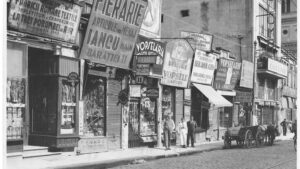
Bucharest: Maps in Motion is an invitation to a journey through time, a visual dialogue between two worlds that coexist within the same space. The history of Romania’s capital resembles a map of continuously shifting geographies, where the street reflects ongoing transformations shaped by everyday concerns and, above all, by the life aspirations of its inhabitants.
Over the past two hundred years, Bucharest has been a true arena of confrontation between the “new” and the “old,” between the Oriental city that stubbornly sought to endure and the modern city that struggled for a long time to take shape. The exhibition illustrates this tension and the different perspectives on Bucharest, from the Belle Époque period—reflected in the documentary materials provided by the Bucharest Municipality Museum—to the present-day face of the capital, captured in detail by photographer Dragoș Asaftei.
From an urban-planning perspective, the construction of a modern city in Bucharest was a priority for the Romanian intelligentsia of the 19th century. From the very beginning, this process aligned with broader European integration trends. The modernization of Bucharest began in the 19th century, marked by the notable urban and municipal achievements of mayors Pake Em. Protopopescu (1888–1891), Barbu Ștefănescu Delavrancea (1899–1901), and Mihail I. Cantacuzino (1901–1906), and was continued in the early 20th century. Mayor Dem I. Dobrescu (1929–1934) sought to redefine Bucharest’s urban identity. His efforts were also reflected in the celebrations of the “Month of Bucharest” (May 9 – June 9), which began in 1935 and concluded in 1940.
Today’s Bucharest is a large city, rapidly expanding with each generation. From a historical perspective, the most important factor is not the political one, but rather the fact that any city, regardless of its age, possesses a single emotional state—one defined by the mood, aspirations, and ideals of the people living within its walls.
Because history, however linear it may appear in school teachings or daily life, always looks toward the people who give it content, form, and above all, appearance. Everything depends on humanity and its evolution within a given period of time—of each generation and, by extension, of each civilization. This humanity, reshaped with every generation entering the active stages of urban professions, succeeds in transforming the city they inhabit into maps in constant motion.
In Dragoș Asaftei’s photographs, one finds, on the one hand, the timeless atmosphere of Bucharest’s winters and nights, which revive the scent of the interwar period and the grandeur of its symbolic monuments. On the other hand, the exhibition celebrates the energy of a living, modern, and vibrant European city. The warm light of autumn and summer reveals a Bucharest of the present—a city of beautiful contrasts, where history and modernity intertwine spectacularly. From images of the Romanian Athenaeum or the Arc de Triomphe wrapped in white, to golden sunrises bathing Unirii Square and the silhouettes of new buildings reflected in the northern lakes, this collection stands as testimony that, when viewed from the right angle, Bucharest offers every day a visual spectacle worthy of admiration, not merely the glance of the hurried passerby.
Dragoș Asaftei is a highly regarded Romanian photographer, born in Odorheiu Secuiesc, aged 32, who came into contact with photography at the beginning of high school. At the age of 18, he began his first photographic project—Flight over Transylvania—in which he captured villages, cities, and the natural landscapes of Transylvania from a small aircraft. For nine years, he served as the official photographer of the President of Romania, documenting moments from the country’s recent history through images. Throughout this period, he continued to promote positive perspectives of Romania, photographing human stories, the charm of rural villages, and the wildness of nature. Since 2018, he has been working on the project Flight over the Mountains of Romania, through which—using aerial photography and filming—he documents the Carpathians, producing materials with both documentary and touristic promotion purposes, as well as environmental conservation goals, highlighting what makes Romania a truly unique and spectacular place.
Exhibition Curators: Adrian Majuru and Dan Pîrvulescu
Photographer: Dragoș Asaftei