

From 9 October 2026
Between Paris and Bucharest: The Story of a Young Woman in the 19th Century
Thematic Exhibition at the Suțu Palace
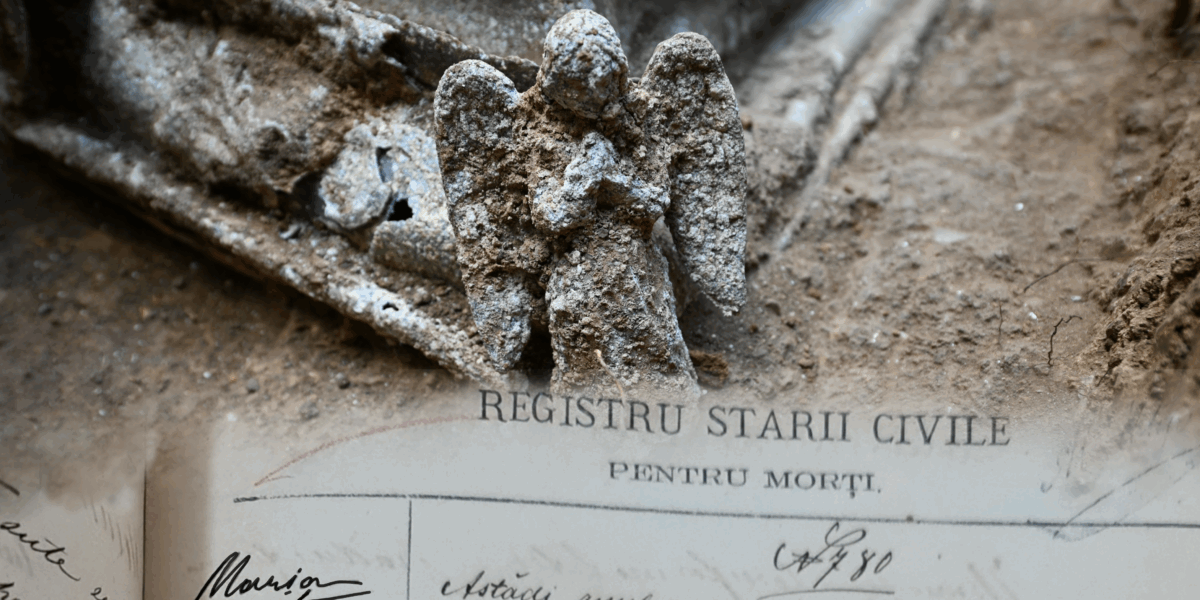
The exhibition invites you to discover a moving history, reconstructed from recent archaeological excavations in the courtyard of the Mavrogheni Church in Bucharest, alongside research in historical archives. At the center of the exhibition is an exceptional zinc coffin, discovered in 2024, which preserves the remains of a young woman only 19 years old, a victim of one of the most feared diseases of the era: tuberculosis.
Mavrogheni Church, founded in 1787 by Prince Nicolae Mavrogheni—then located on the outskirts of the city near Podul Mogoșoaiei—was part of a vast complex that included windmills, a pavilion, and gardens. Although burials within cities had been prohibited as of 1864, the church cemetery continued to receive prominent individuals until the beginning of the 20th century. Archaeological excavations begun in 2018 led to the identification and investigation of 137 graves dated between the late 18th century and the early 20th century.
The most impressive funerary complex was found in front of the church entrance: a trapezoidal zinc coffin, supported by six legs, with a richly decorated lid featuring little angels at the corners, skulls, frames, and enameled details. The coffin was fitted with two superimposed lids: an outer, airtight one, fastened with rivets, and an inner one with a cut-out in the head area covered by glass, allowing the deceased to be viewed without risk of contamination.
The young woman’s skeleton was remarkably well preserved: her hair and part of the skin on her back remained intact. Anthropological analysis revealed extensive lesions to the spine, ribs, and sinuses, characteristic of severe multifocal tuberculosis complicated by chronic sinusitis. Although she likely received treatment in one of the few specialized European sanatoria of the time, the disease proved fatal.
The exhibition reconstructs the tragic journey of this young woman: beginning in Paris, her birthplace; continuing through European sanatoria; her death in Budapest in 1872; and finally her arrival in Bucharest, where she was buried. Her story illustrates the desperate struggle against the “white death” in an era marked by medical limitations. Through artifacts, photographs, and documents, visitors will encounter a deeply human story about the fragility of life in the 19th century.