


THEMATIC EXHIBITION AT THE LIGIA AND POMPILIU MACOVEI ART COLLECTION
“From Filaret Lane to 11 June Street”
Through this exhibition project, we invite you to discover the story of an area of Bucharest that once stood at the city’s edge but gradually became the witness of essential events in the history of modern Romania. Filaret Lane, a street on the outskirts during the medieval period—recorded as a road and name since the 18th century and starting behind the Metropolitan Church toward Șerban Vodă Road—became in 1878 11 June Street, a name recalling the day of victory of the 1848 Wallachian Revolution. Right here, on Filaret Field, the revolutionaries proclaimed freedom in June 1848, transforming an ordinary site into a genuine symbol of the desire for change.
On 11 June Street we can trace the evolution of housing, from the 19th century to the end of the interwar period, observing its architectural styles and discovering, as in the whole capital, aspects of a way of life specific to Bucharest—testimony to the daily life of the communities that shaped it. The street thus reflects Bucharest’s transformation from a peripheral mahala to an important urban zone. Initially inhabited by craftsmen, vegetable growers, and merchants, the street gradually became home to an urban middle class, made up of clerks, teachers, and workers from the factories in the south of the city.
Its architecture preserves varied layers: boyar and merchant houses from the 19th century, Neo-Romanian villas, and interwar Art Deco buildings, alongside landmarks such as St. Nicholas Vlădica Church, Filaret Station, and the Gas Works. The street gained importance due to its link between the Metropolitan Hill and Filaret Field, a place of fairs, public gatherings, and large exhibitions (1848, 1906, 1935). Thus 11 June Street encapsulates the history of the city in miniature—from the traditional mahala to the modern neighborhood, shaped by social, economic, and symbolic changes.
After the 1848 revolution, the area gradually gained a new identity. Filaret Field became the Field of Liberty, and half a century later, in 1906, it was chosen as the site for the events celebrating the 40-year reign of King Carol I. In 1921, the Tomb of the Unknown Soldier was placed in front of the park’s main building, the Palace of Arts. The first edition of “Bucharest Month” (Luna Bucureștilor) was also held here in 1935, and later the Antonescu regime planned to build a national heroes’ memorial in the same area.
The political change that occurred after the Second World War did not obscure the park but transformed it into one of the regime’s major propaganda landmarks by renaming it Liberty Park and building there the mausoleum dedicated to communist leaders, called the “Monument of the Heroes of the Struggle for the Freedom of the People and the Fatherland, for Socialism,” an intervention that structurally altered the park’s appearance. Thus, at the end of 11 June Street we find a place with overlapping histories, each bearing the significance imposed by the regime in power over the last century and a half, culminating in the intention to build the Cathedral of the Salvation of the Nation there. After December 1989, the park returned to its previous name, Carol Park.
Integrated within the park, we find the beautiful fountain erected in 1870 by George Grigore Cantacuzino on the site of an earlier one built by Filaret II, the man who gave his name to the area. Filaret II, a monk from the Căldărușani Monastery, gradually rose through the church hierarchy and became Metropolitan of Wallachia between 1792 and 1793, although he soon resigned and retired to Căldărușani, where he died in 1794. He remains known in Bucharest’s memory for the “Metropolitan Filaret Fountain,” a monumental structure built on his estate that gave the Filaret area (Filaret Field and Filaret Hill) its name. His cultural activities were remarkable, contributing decisively to the first Romanian translation and printing of the twelve volumes of the Menaion (1776–1780), among other liturgical books.
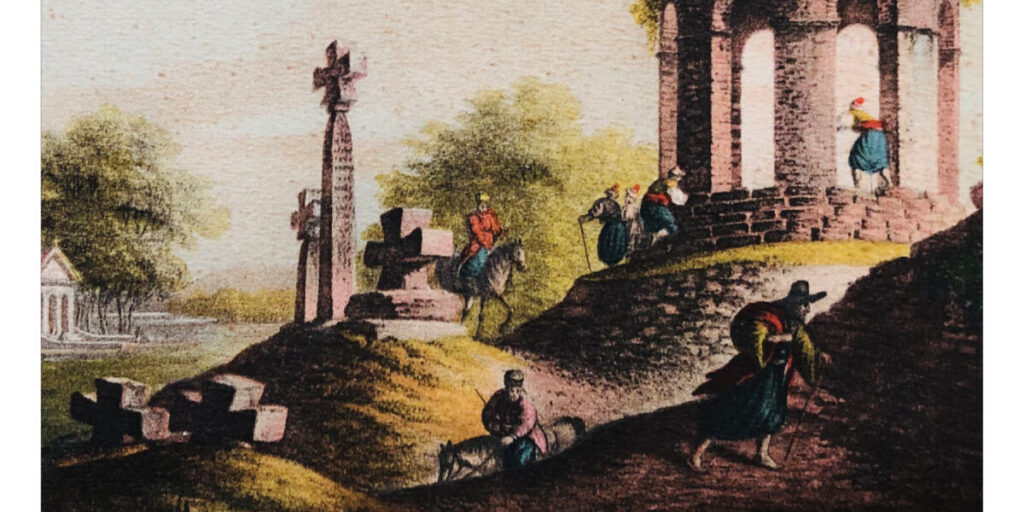
The exhibition presents archaeological objects found in Bucharest from the 18th and 19th centuries, helping us imagine the lives of the mahalagii (neighborhood residents) of those times. Maps allow us to outline this area by identifying key points around which we uncover a city edge constantly transforming—abandoning traditional occupations and making room for the new trades of urban modernity. Through visual arts, especially engraving, we step into the atmosphere of the 19th century, into the landscape that dominated this area: the Metropolitan Hill and Filaret Field. Paintings and engravings depict the figures who changed Romanian society and who chose to turn Filaret Field into the Field of Liberty in 1848. Alongside them are printed documents supporting the actions of these figures. Photography appears as a more recent document, offering an overview of the neighborhood in the 20th century.
We frame all these aspects of urban evolution in the intimate space of the museum hosting the Ligia and Pompiliu Macovei Art Collection, aiming to highlight moments from the Vlădica-in-Prund mahala, part of the former Blue Sector—once an area of vineyards and vegetable gardens that later became a quiet neighborhood, its calm interrupted only by the sound of the tram as it headed toward the great Filaret garden, Carol Park.
The exhibition is the result of collaboration between the departments of the Bucharest Municipality Museum, which provided the heritage needed to create this project: the Systematic Archaeology and History Department, the Preventive Archaeology Department, the Art Department, the Heritage and Centralized Records Department, and the Documentation, Library, Archive, and Communication Service.
Museum curators:
Dr. Cezar Petre Buiumaci, Florentina Limban, Mirela Murariu